



Ecommerce Marketing Strategies: A Beginner's Guide
Published by Incomedia in Web marketing · Wednesday 28 Oct 2026 · 19 minutes
You've finally launched your online store. Your product photos look great, every listing is complete, checkout works perfectly, and you even placed a test order just to be safe. You hit publish, wait... and nothing happens. A few visits (probably friends and family), zero orders, and the nagging feeling that you've built a beautiful little shop on a dead-end street where nobody ever walks by.



It happens far more often than you'd think, and it's not your fault: launching an e-commerce store is only the first step. An online store doesn't market itself. It needs a plan to get found, to win over the people who land on it, and to bring past customers back for more.
In this guide, we'll walk through the most effective ecommerce marketing strategies, organized around three goals: driving qualified traffic, turning visits into sales, and building customer loyalty. You don't need a big-brand budget or a marketing degree. You just need to understand which levers are available, in what order to pull them, and what to expect from each one.
To keep things practical, we'll follow an example: Martha, who built a small online store for her handmade ceramics with WebSite X5 and now wants to get the word out. If your store doesn't exist yet and you're starting from scratch, we recommend beginning with our guide on how to build an online store with WebSite X5, then coming back here once you're ready for your first visitors.
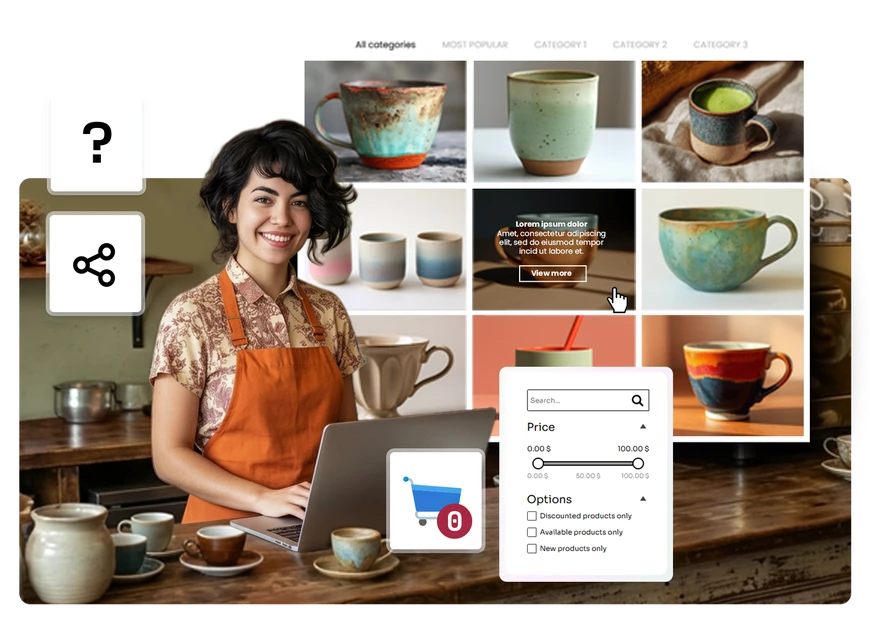
Martha in her ceramics studio: the store is ready, but the customers aren't coming.
Ecommerce Marketing: What It Is and Why You Need It
Picture a gorgeous ceramics shop tucked away on a dead-end street, with no sign out front and no one aware it exists. The shelves are neat, and the pieces are beautiful, but the door stays closed because nobody stops by. An online store without marketing is in exactly the same spot: technically it's open to everyone, but in practice no one sees it.
Ecommerce marketing is the set of activities an online store uses to build awareness, drive people to the website, guide them to a purchase, and keep them connected to the brand over time. It includes SEO, paid advertising, social media, email marketing, content, and customer service. You'll also hear terms like online store marketing or ecommerce digital marketing: they all refer to the same thing, with slightly different nuances. The bottom line is that none of these channels really works on its own, which is why more and more people talk about an integrated ecommerce marketing strategy: different levers working together toward the same goal.
The difference from a brick-and-mortar store matters. A shop on Main Street can count, at least in part, on foot traffic: someone stops in front of the window by chance. Online, walk-in traffic barely exists. People arrive because they searched for something on Google, saw a post, received a message, or got a recommendation from someone. Every one of those entry points has to be built and, above all, planned.
Here's what a well-designed marketing strategy can actually do for you:
- A bigger customer base. Your store can reach people who will never walk down your street or visit your town, and who are searching for exactly what you sell right now.
- A presence on the right channels. Search engines, social media, email, marketplaces: being where your customers are lets you get chosen at the very moment they're considering a purchase.
- Repeat customers. People who have already bought from you and had a good experience are the easiest audience to win over again, as long as you don't lose track of them after delivery.
- More consistent communication. Newsletters, social media, and customer support let you stay in touch without waiting for customers to make the first move.
- Anticipating needs. By watching what people browse, search for, and buy, you can figure out what might interest them before they even ask.
These benefits don't all arrive at once, and they don't arrive overnight. That's why it makes sense to have an ecommerce marketing plan: a sequence of clear choices, even small ones, instead of a thousand scattered attempts. In the rest of this guide, we'll show you how to build one.
The 3 Pillars of a Winning Ecommerce Marketing Strategy
To make sense of the dozens of possible tactics, it helps to picture the customer journey as a funnel. Lots of people who don't know you yet enter at the top. As you move down, the number of people shrinks, but those who remain are getting closer and closer to buying. Each stage calls for a different approach, and successful ecommerce marketing strategies cover all three.
The first stage, attraction, is about bringing people who are interested in what you sell to your site. The goal is traffic, but not just any traffic: what counts are visitors who have a real reason to stick around. Conversion turns those visits into orders by removing anything that might hold the purchase back. Finally, retention brings past customers back and turns a first order into a lasting relationship.
The three stages of the strategy and the levers we'll cover in each one. The diagram isn't to scale: it shows the journey, not the proportions.
It's tempting to focus only on the first pillar, since more visits always feel like good news. But driving traffic to a site that doesn't convert is like paying to fill a store where the register is hard to find, and ignoring retention means starting from zero with every sale. You can take it step by step. What matters is knowing which path your customers follow and which stages of the funnel need work to make the whole process more effective. To learn more about how content guides people along this journey, check out our guide to content strategy and the sales funnel.
1. Strategies to Drive Qualified Traffic to Your Online Store
Before choosing your channels, it's worth clarifying what qualified traffic means: visits from people who are genuinely interested in what you sell, not just a lot of visits. A hundred visitors who were specifically looking for a handmade ceramic mug are worth far more than a thousand who showed up out of curiosity and left after a few seconds.
To reach them, ecommerce marketing strategies fall into two broad families. The first reaches people who are already searching for something: this is the world of search, with SEO and Google Ads. The second introduces your store to people who didn't know they needed it yet: this is the world of social media, platform advertising, and influencer marketing. The two aren't mutually exclusive. The first brings in people with strong purchase intent, while the second expands the audience that gets to know your brand.
The two families of strategies for driving traffic to your store: people who search and people who discover.
Ecommerce SEO and Product Pages: Organic Visibility on Google
SEO (search engine optimization) is the set of practices that help your site show up in Google's results when someone searches for what you sell, without paying for every click. It takes time, but in the long run it delivers steady traffic. That's why ecommerce SEO is usually the first building block of a solid strategy.
For an online store, SEO comes down mostly to category pages and product pages. Martha, for example, doesn't just sell “mugs”: she sells “handmade ceramic mugs,” “ceramic breakfast sets,” and “stoneware bowls.” Those are the words her customers type into Google, and they should appear naturally in page titles, descriptions, and web addresses (URLs). It's just as important to write unique descriptions: copying the manufacturer's text, which appears word for word on dozens of other sites, helps neither search engines nor shoppers.
The difference between a neglected product page and an optimized one is easy to see in an example:
- Element: Title
- Neglected product page: Mug 01
- Optimized product page: Handmade Cercamic Mug, Blue Haze
- Element: Web address (URL)
- Neglected product page: /product?id=12
- Optimized product page: /mugs/handmade-ceramic-mug
- Element: Description
- Neglected product page: One line copied from the manufacturer
- Optimized product page: A few original lines: how it's made, how many ounces it holds, how to care for it
The product is the same, but in the second version Google understands what it is, and anyone who lands on the page finds exactly what they expected.
Photos are part of the game too. Sharp images with a clear file name and alt text that describes the content improve the shopping experience and help Google understand what you're selling. For practical tips on how to shoot them, see our guide to ecommerce product photography.
Google Shopping and Google Ads: Reach Shoppers Ready to Buy
SEO takes patience, while paid advertising gets you visible right away. With Google Ads, you can show ads to people searching for specific keywords and pay only when someone clicks (that's what pay-per-click, or PPC, means). Then there's Google Shopping: those listings with a photo, price, and store name that appear in the results when someone searches for a product. To use them, you upload your product catalog to Google Merchant Center, Google's tool for online retailers.
For each product, Google asks for some basic data: a unique ID, title, description, the product page URL on your site, an image, price, and availability, plus shipping information. One detail that's often overlooked is that the data you upload must match what's on your site: if the price or availability doesn't line up, the product may not be shown. So update your product feed every time you change a price or run out of stock.
The advantage of these ad formats is intent: someone who types “ceramic breakfast set” is almost always weighing a purchase. The risk, especially for beginners, is overspending without tracking results. That's why it's smart to start with a modest budget, focus on a handful of products, and check every week how much you're spending compared to how much you're earning.
Which products should you start with? Usually the ones with the best photos, a margin that can absorb the cost per click, and inventory in stock: there's no point paying to drive traffic to a product you can't ship. Every week, look at three numbers: how much you spent, how many orders came in, and how much revenue you earned for every dollar invested (known as return on ad spend, or ROAS). If a product eats up budget and doesn't sell, pause it and try another one instead of raising your spend and hoping things change.
Another useful concept is retargeting (also called remarketing): showing ads to people who have already visited your site without buying. It's like window-shopping without going in, then seeing a billboard for that same product on your way home. Used in moderation, without being pushy, it can bring back people who were one step away from buying.
Social Media Ads and Influencer Marketing: Get Discovered
Social media works differently from search engines. People aren't looking for a product here: they're scrolling for fun, and if something catches their eye, they may decide to learn more. That makes social platforms ideal for building brand and product awareness, especially for visually striking products. A hand-glazed ceramic piece filmed as it comes out of the kiln says more than a thousand words.
With social media ads, you can show your content to audiences targeted by interests, age, location, or behavior. Here too, it's best to start small: test a few ad creatives and see which one drives the most visits.
For a ceramics shop, the content that performs best is often the kind that shows the work behind the product: the moment the kiln opens, a side-by-side of a raw piece and a glazed one, the mug in use at breakfast, a package being wrapped for a customer. This content shows who's behind the store and helps you stand out from sellers who only post product shots on a white background.
Influencer marketing is another path to discovery. For a small store, micro-influencers often work better than big names: people with a smaller but highly engaged following that's close to your niche. The right audience matters more than the follower count: a creator who talks about home, cooking, or crafts with an engaged community will drive more valuable traffic than a huge profile that has nothing to do with your products.
Our advice, then, is to choose creators whose audience truly fits your products. Agree clearly on what will be posted, and remember that in the US the FTC requires paid partnerships to be clearly disclosed (for example, with #ad or the platform's paid partnership label).
2. Ecommerce Conversion Rate Optimization
Let's say the visits start rolling in. Now the second pillar comes into play: getting those people to buy. Conversion rate optimization (CRO) starts from a simple idea: remove friction, meaning all the little obstacles that make buying harder than it needs to be. A shipping cost that only shows up at the last step, a form that's too long, a photo that doesn't show how big the product is: any one of these details can change the mind of someone ready to buy.
The right perspective is the customer's, asking at every step whether they have all the information they need to decide and whether moving forward is easy. To find out where people drop off, look at the data. If you'd like to learn more, our guide on how to track a website built with WebSite X5 explains how to read the purchase journey, from product view all the way to order.
How to Create an Effective Product Page
The product page is where visitors make up their minds. It needs to answer every question they'd ask a sales associate: what it looks like, what it's made of, how big it is, how to use and care for it, how much it costs, and when it will arrive. Missing information? Online shoppers can't pick the item up and, when in doubt, they usually leave.
A good product page answers, point by point, the questions a customer would ask at the counter. In the example below, Martha's mug, each numbered callout marks one of the elements that matter. If you want a step-by-step method, you'll find everything in our guide on how to create an optimized product page.
The elements of an effective product page, using a handmade ceramic mug as an example.
Three details deserve extra attention. The photo should convey scale: online, shoppers can't hold the item, and a point of reference, like a ruler, clears up a lot of doubts. The description should explain what changes for the buyer, not just list materials and dimensions. Finally, shipping and return information should be easy to find without searching for it: these are among the questions that most often make people change their mind on a purchase.
How to Reduce Abandoned Carts
An abandoned cart is when someone adds products to their cart but doesn't complete the order. It happens to every ecommerce store, and it shouldn't be read as a failure: often the person was just comparing options or got interrupted. Some of these carts, though, can be recovered, especially if you figure out why people stop.
The most common causes include unexpected costs (like shipping) revealed only at the end, being forced to create an account before paying, a checkout with too many steps or fields, and the lack of the customer's preferred payment method. Each of these has a simple fix.
To decide where to start, this table connects what you observe with the most useful fix:
- People drop off when shipping costs appear: Show shipping costs and delivery times on the product page and in the cart
- Many leave when asked to create an account: Offer guest checkout
- Checkout is abandoned halfway through filling in details: Keep required fields to a minimum
- Shoppers reach payment and can't find their preferred method: Offer familiar, secure payment methods such as credit cards, PayPal, Apple Pay, or Shop Pay
- Carts are left with products inside: Send an abandoned cart reminder email, as we'll see in the retention section
How to Increase Average Order Value: Upselling and Cross-Selling
Growing revenue doesn't only mean bringing in more customers: you can also help each customer buy a little more when it's genuinely useful to them. That's the idea behind average order value (AOV), the average amount spent per order. Two widely used techniques are upselling and cross-selling.
Upselling means offering a more complete or higher-end version of the product someone is looking at. A small price advantage, for example, can make it worth upgrading from a single piece to a set. Cross-selling, on the other hand, suggests complementary products that round out the purchase. Another lever is a free shipping threshold: showing how much more a customer needs to spend to qualify encourages many shoppers to add one more item. In the diagram below, you'll see the first two techniques applied to Martha's mug.
Upselling and cross-selling compared, using the same product: the mug.
What matters is that suggestions are relevant and not intrusive: a sensible recommendation feels like a service, not pressure. Promotions and discounts also need to be handled carefully; to learn when and how to use them, read why discounts matter for an online store.
Trust Signals: Reviews, Security Badges, and Easy Returns
Buying from an unfamiliar store takes a leap of faith. Shoppers on the other side of the screen want to know that the site is secure, that the product matches the description, and that someone will respond if something goes wrong.
Customer reviews are one of the most effective tools because they come from people just like them. Display them honestly, including the less enthusiastic ones: a wall of nothing but five-star reviews can seem hard to believe. Security badges (the padlock of an HTTPS certificate, the logos of accepted payment methods) provide reassurance at the sensitive moment of payment. Finally, a clear and simple return policy takes away the fear of making a mistake: shoppers who know they can easily send a product back are much more likely to buy. In the US, there's no single federal return window for online purchases, so it's up to you to set one (many stores offer 30 days). Check with your advisor about any state rules that apply, and state your policy clearly on your site.
The details matter too: displaying your business name, contact information, a phone number or email address that someone actually answers, and easy-to-find Privacy Policy and Terms of Service pages show there's a real business behind the website.
3. Customer Retention Strategies to Drive Repeat Purchases
A first purchase isn't the finish line: it's the start of a relationship. Customers who have already bought from you know you, trust you, and have experienced your service firsthand. Bringing them back to your site usually takes less effort, and less budget, than winning over someone completely new. That's why retention is often the most neglected pillar and, at the same time, one of the most profitable.
Email Marketing Automation
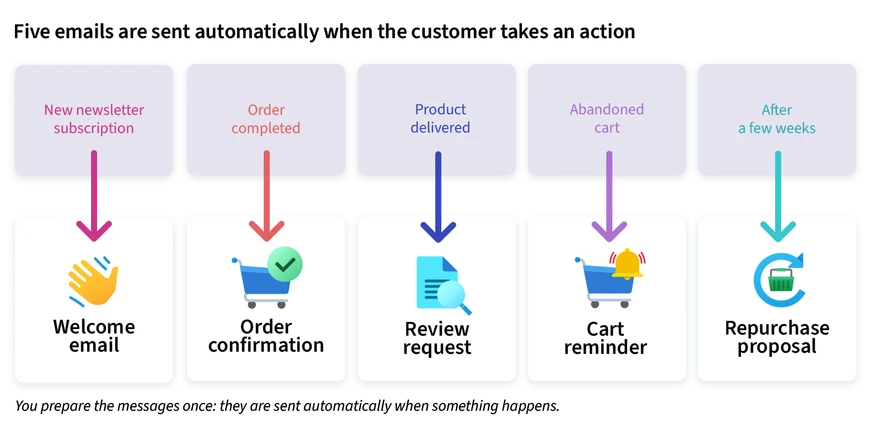
Email remains one of the most effective channels for staying in touch with customers, because it lets you talk to people who have already shown interest. Here's how email marketing automation works: you write a few messages once and set them to go out automatically when something happens, such as a new subscriber, a completed order, or an abandoned cart.
For a small store, a few well-planned automated emails are enough, one for each key moment in the customer journey: the diagram below shows five. Remember to comply with the CAN-SPAM Act: every marketing email needs a working unsubscribe option and your business's physical mailing address. To learn how to set up your campaigns step by step, read our guide to effective email marketing.
Five automated emails for a small store: each one is triggered by a customer action.
You can turn them on one at a time: start with the order confirmation and the welcome email, the easiest to set up, and add the others as you go. The repeat-purchase email works best when it suggests something that complements what the customer already bought, like a saucer for Martha's mug.
Loyalty Programs, Gamification, and Exclusive Discounts
Rewarding customers who come back is a concrete way to say thank you while giving them one more reason to buy again. Loyalty programs can be very simple: points that add up with every purchase and turn into a discount, a perk after a certain number of orders, or a birthday gift.
Gamification adds an element of play to customer loyalty: levels to reach, limited-time challenges, small milestones that unlock a reward. Simple systems are enough: even a single seasonal campaign can make the experience more engaging. Exclusive discounts (a code for newsletter subscribers, early access to new products, a private sale) make customers feel like part of an inner circle. In WebSite X5 you can also run discounts and promotions with coupon codes, so creating a code for your customers is easy. The rule of thumb is consistency: choose perks your margins can support and that customers understand at a glance.
Direct Messaging and Personalized Customer Service
Customer relationships are also built after the sale, when something doesn't go as planned or simply when a question comes up. Responding quickly, with a human touch, is one of the few ways a small store can beat the online giants.
Live chat on your site, a messaging channel like WhatsApp Business or Facebook Messenger, or a well-monitored email inbox makes you easy to reach. A well-written FAQ section, on the other hand, answers the most common questions about shipping, returns, and payments on its own, lightening your day-to-day workload. Even a small personal touch, like a handwritten note in the package or a message asking whether the order arrived safely, leaves an impression no ad campaign can buy.
How to Manage Your Ecommerce Marketing with WebSite X5
So far we've talked about strategy. The next step is having tools that let you put it into practice without overcomplicating your life. With WebSite X5, you can build your online store visually, without writing code, and manage content, pages, and marketing settings from a single program. Ecommerce features are included in the Pro and Agency editions.
To help you get found, WebSite X5 automatically generates a page for each product and provides structured data for SEO, which helps Google understand what you sell; you can also manage tags and the sitemap. If you have a large catalog, like Martha with her ceramics, you can bulk-upload products with a .csv file. To write complete descriptions without staring at a blank page, you can get help from MagicText, the AI writing assistant: it suggests a first draft that you then review and personalize with the real details of your products.
To turn visits into orders, you'll find the tools to remove the friction we've discussed: multiple payment methods, including credit cards and PayPal, a search engine and filters to find the right product quickly, product variants, inventory management, and product reviews, one of the most effective trust signals. The cart is customizable and, to encourage purchases, you can set up discounts, promotions, and coupons.
To bring past customers back, you can use user registration and a members-only area to create a dedicated space for your store's customers, plus contact form and chat objects you can add to your pages to stay in touch and answer questions quickly.
To measure results, WebSite X5 integrates with Google Analytics and Google Search Console, so you can see which channels drive visits and orders and where it pays to invest.
If you're just getting started, MagicSite, WebSite X5's AI, helps you create a first project draft to customize, so you don't have to start from a blank page. You can explore everything on the WebSite X5 features and integrations page, or read why you should choose WebSite X5 to build your website.
Ecommerce Marketing FAQ
Before we wrap up, let's answer the most common questions from people taking their first steps in marketing their online store: where to start, how long to wait for results, and how to tell if you're heading in the right direction.
What is ecommerce marketing and why do you need it?
Ecommerce marketing is the set of activities an online store uses to build awareness, bring visitors to the site, guide them to a purchase, and bring them back. You need it because, unlike a store on a busy street, nobody stumbles onto a website by chance: without a plan to get found, even the most polished site risks staying invisible.
How can I market my online store on a small budget?
Start with what mostly costs time: well-crafted product pages, unique descriptions, quality photos, a welcome email, and an order confirmation email. These offer a strong return on effort. Only then does it make sense to add a small paid campaign focused on a few products, checking every week how much you're spending versus how much you're earning. One channel done well beats five left half-finished.
Is SEO or paid advertising better for ecommerce?
They're not alternatives, because they do different jobs. Paid advertising brings visits immediately, but stops the moment you stop paying. SEO takes longer, but builds visibility that keeps working over time. For a new store, it usually makes sense to lay the SEO groundwork from day one and use paid ads strategically to give a boost to the products you want to promote.
How long does it take to see results from ecommerce marketing?
It depends on the lever. Paid ads can bring visits within the first few days. SEO takes more patience: think in months rather than weeks. Email marketing grows as your subscriber list grows. That's why it makes sense to look at trends over time, rather than expecting an immediate change after every single tweak.
How do I know if my marketing strategies are working?
By tracking a few metrics, always the same ones: where your visits come from, how many turn into orders (your conversion rate), how much buyers spend on average, and how many customers come back. Tools like Google Analytics and Google Search Console show you this data. If you want a simple method to get started, you'll find everything in our guide on how to track a website built with WebSite X5.
Do I need email marketing if I only have a few customers?
Yes, precisely because you have only a few: every customer counts, and a thank-you email, a request for feedback, or an abandoned cart reminder can make a real difference. A handful of automated emails, set up once, is all it takes. Just make sure your emails follow CAN-SPAM rules and respect your subscribers' privacy.
Conclusion and Next Steps
Let's go back to that shop on the dead-end street. Martha's problem was never the store, which was beautiful: it was the roads leading to it. An e-commerce marketing strategy exists for exactly this reason: to build those roads and make sure whoever travels them finds an open door, an easy path, and a good reason to come back.
If all of this feels like a lot, start with three moves, one for each pillar:
- Attraction: pick just one channel to focus on at first (usually product page SEO, or a small paid campaign) and give it consistent time.
- Conversion: walk through the purchase journey through a customer's eyes and remove the first obstacle you run into, whether it's a hidden cost, unclear copy, or a hard-to-find button.
- Retention: set up your first automated email, for example, a thank-you message after purchase.
Once you've set your priorities, it helps to have a plan over time: our guide to creating a marketing calendar shows you how to organize activities and deadlines without losing track.
Marketing isn't a sprint. It's a journey made of small steps, measured and adjusted over time. Start with one, see what happens, and then add the next.